Myanmar's New Anti-Scam Law Explained: Can It Stop the Global Fraud Industry?
Myanmar Declares War on Scam Centers: New Law Introduces Life Imprisonment and the Death Penalty
For years, Myanmar has been associated with one of the fastest-growing forms of transnational organized crime: industrial-scale online fraud. Vast scam compounds operating near the country's borders have become notorious for running cryptocurrency investment scams, romance fraud, and other online schemes that have targeted victims around the world.
Now, Myanmar's military-backed government is responding with its toughest legal measure yet. Parliament has approved the Anti-Online Scam Bill, introducing penalties ranging from lengthy prison sentences to life imprisonment and, in the most serious cases, the death penalty.
The legislation reflects mounting international pressure on Myanmar to address an industry that has evolved into one of Southeast Asia's largest criminal enterprises.
Why Myanmar introduced a new anti-scam law
The new law was approved by Myanmar's Union Parliament on July 28, following a joint session of both legislative chambers in Naypyidaw.
The legislation is designed to combat not only online fraud but also the broader criminal ecosystem that supports it, including human trafficking, forced labor, money laundering, and cryptocurrency-enabled financial crime.
Under the new rules, individuals who organize scam compounds or participate in human trafficking networks face prison sentences ranging from 10 years to life imprisonment.
The most severe provision allows courts to impose the death penalty when scam operators abduct victims, detain them illegally, subject them to torture or abuse, force them to participate in online fraud, and those actions ultimately result in a victim's death.
The law represents one of the harshest legal responses to cybercrime anywhere in the world.
How Myanmar became a global scam hub
The rise of Myanmar's scam industry did not happen overnight.
Following the military coup in 2021, parts of the country's border regions fell increasingly outside the effective control of the central government. Criminal organizations took advantage of weak governance to establish large compounds officially presented as casinos, tourism projects, or special economic zones.
Many of these developments eventually evolved into highly organized scam centers.
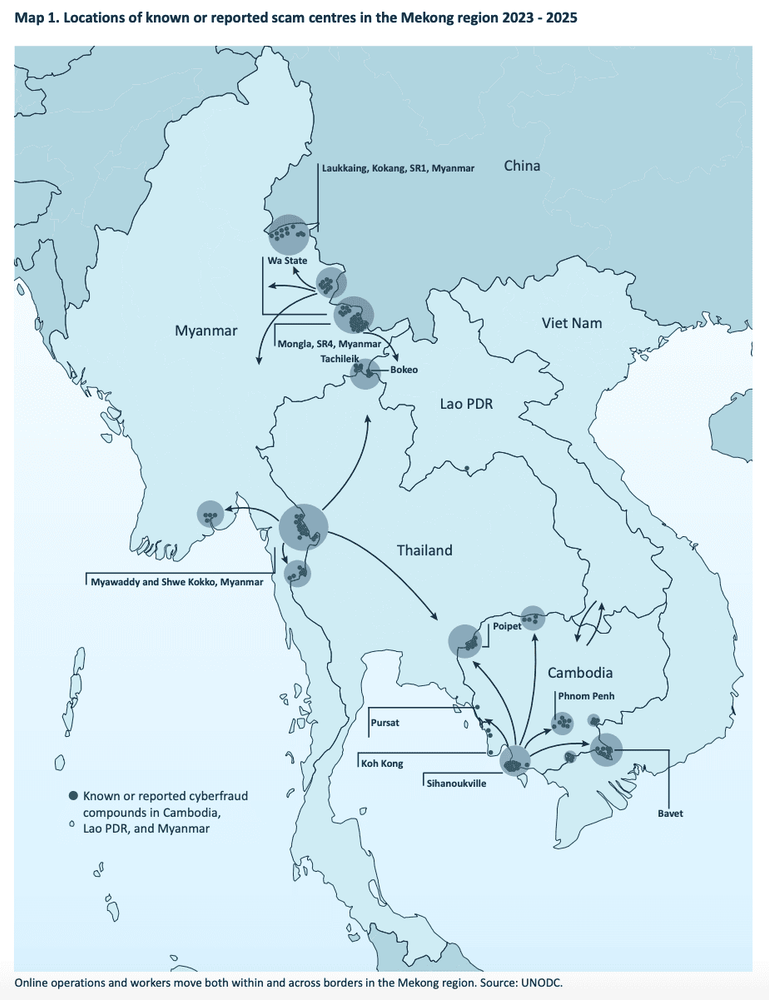
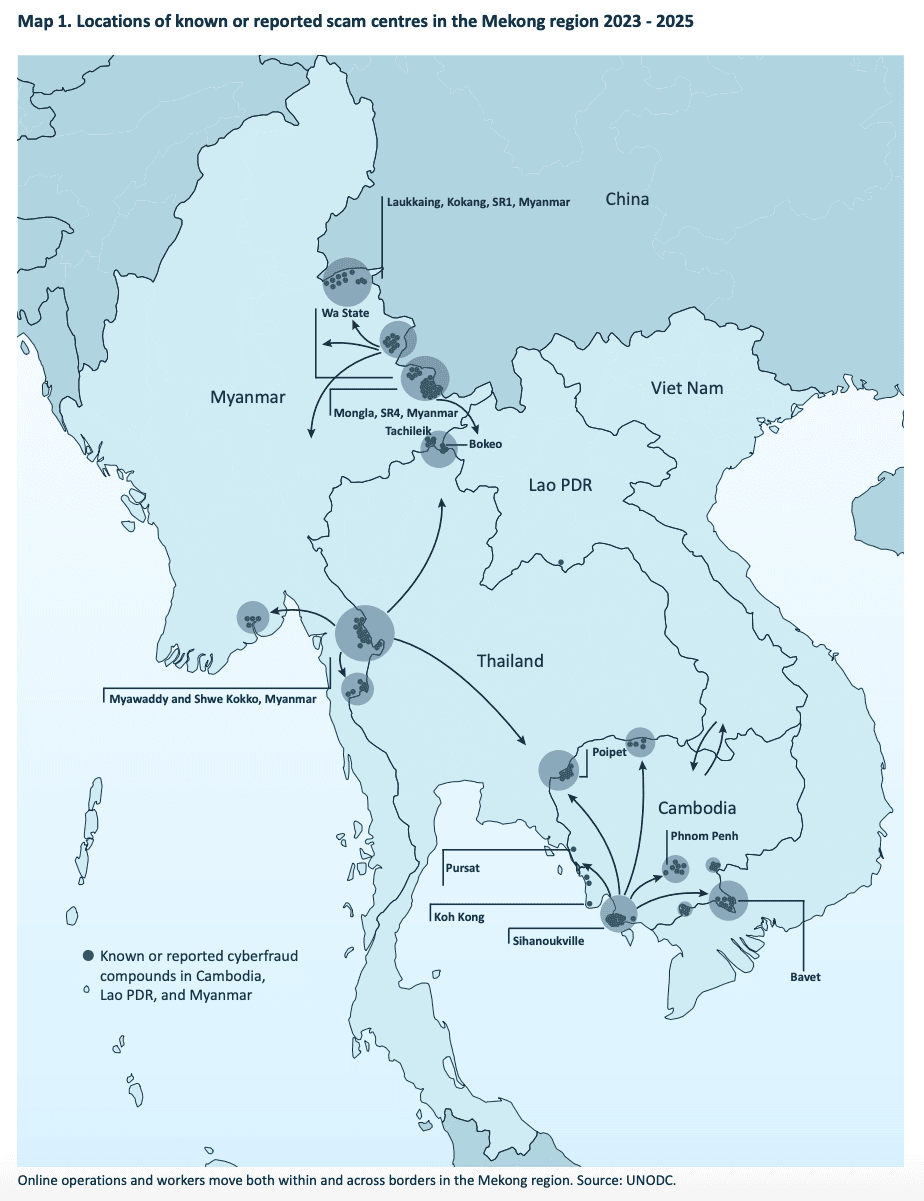
According to international organizations, roughly 60 major scam compounds now operate along the Myanmar–Thailand border, employing or coercing an estimated 150,000–200,000 people.
These facilities have become industrial-scale operations capable of targeting victims across Asia, Europe, North America, and Australia.
Inside the scam compounds
One of the most widely known locations is KK Park, which has repeatedly appeared in investigations conducted by international media outlets and organizations including Reuters, BBC, Chainalysis, and the United Nations.
The compound is believed to specialize in several forms of online fraud, including:
- cryptocurrency investment scams;
- romance scams;
- fake trading platforms;
- "pig butchering" schemes, in which criminals spend weeks or months building trust with victims before convincing them to transfer large sums into fraudulent crypto investments.
Modern scam operations increasingly rely on advanced technology, including generative artificial intelligence, stolen personal data, fake online identities, bot networks, and cryptocurrency payment systems.
According to the United Nations Office on Drugs and Crime (UNODC), a single large scam compound can generate tens of millions of dollars every month.
Human trafficking fuels the industry
Perhaps the most disturbing aspect of Myanmar's scam economy is that many of its workers never intended to become criminals.
Recruiters advertise legitimate-looking jobs in information technology, hospitality, logistics, digital marketing, and online sales. Candidates are flown into Bangkok before being transported to Thailand's border town of Mae Sot.
From there, victims are secretly taken across the Moei River into Myanmar.
Once inside the compounds, passports and mobile phones are confiscated, movement is restricted, and workers are forced to spend up to 17 or 18 hours a day conducting online scams.
Those who fail to meet financial targets reportedly face beatings, torture, isolation, or resale to other criminal compounds.
International organizations have repeatedly described these operations as a modern form of human trafficking and digital slavery.
Why cryptocurrencies play a central role
Cryptocurrencies have become one of the preferred financial tools for scam networks.
Digital assets enable rapid cross-border transfers without relying on traditional banking infrastructure, making it easier for criminal groups to move money internationally.
Investigations by Reuters and blockchain analytics firms such as Chainalysis have shown that stolen funds are often routed through multiple cryptocurrency wallets, over-the-counter brokers, and underground payment networks before eventually being laundered through casinos, property investments, or other businesses across Southeast Asia.
While blockchain transactions are traceable, sophisticated laundering techniques continue to challenge investigators.
International pressure has intensified
Myanmar's new legislation comes amid growing international efforts to dismantle scam networks across Southeast Asia.
In recent years, the United States has imposed sanctions on organizations linked to cyber fraud and human trafficking in Myanmar and Cambodia.
Regional governments have also stepped up enforcement.
Thailand has repeatedly conducted raids near the border, cut electricity and telecommunications services to suspected scam compounds, tightened visa controls, and increased financial monitoring.
International law enforcement agencies have also coordinated operations targeting cryptocurrency laundering networks connected to online fraud.
Despite these efforts, experts believe many criminal organizations are already relocating parts of their operations to other countries while expanding their use of artificial intelligence and decentralized financial technologies.
Can the new law stop the scam industry?
The Anti-Online Scam Bill demonstrates that Myanmar now officially recognizes online fraud as a major national security issue rather than simply a criminal justice problem.
However, many analysts remain skeptical that harsher penalties alone will dismantle an industry worth billions of dollars annually.
The greatest obstacle remains geography and governance.
Many scam compounds operate in territories controlled by armed ethnic organizations rather than the central government, limiting the authorities' ability to enforce the new law.
At the same time, the criminal groups behind these operations have become increasingly transnational, shifting infrastructure, financial networks, and personnel across Southeast Asia whenever pressure intensifies.
Conclusion
Myanmar's Anti-Online Scam Bill marks one of the toughest legal responses yet to the global cybercrime industry, signaling that authorities now view scam compounds as a major national security and international reputational threat. However, the law's long-term impact will depend less on the severity of its penalties and more on the government's ability to dismantle scam networks operating in border regions that remain outside its effective control.
Recent News









All Time High • Live
Have questions or want to collaborate? Reach us at: [email protected]