Thailand's Biggest Crypto Mining Bust Reveals the Hidden Cost of Bitcoin
Thailand Uncovers One of Its Largest Illegal Crypto Mining Operations
Thailand has dismantled one of the country's largest illegal cryptocurrency mining networks, highlighting how the rapid growth of digital assets is creating new challenges not only for financial regulators but also for energy infrastructure and law enforcement.
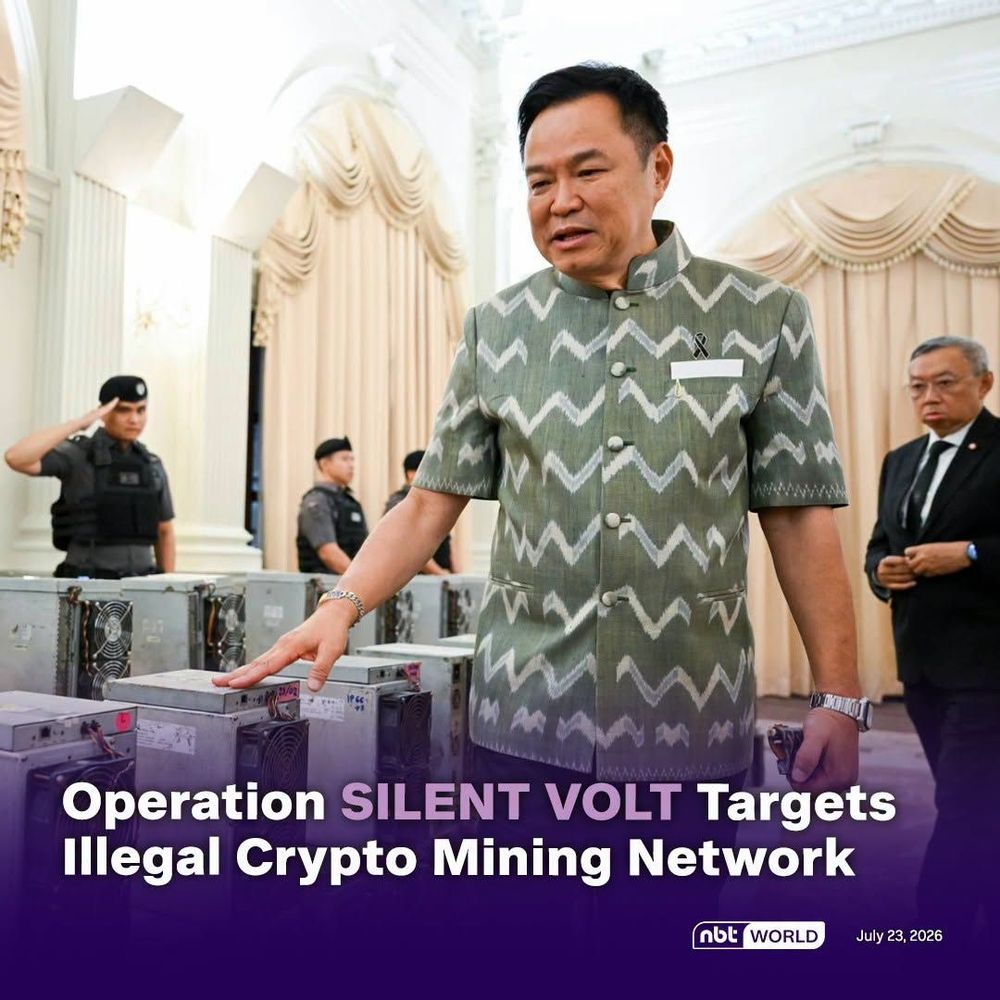
The operation, code-named SILENT VOLT, led to the seizure of approximately 1,900 cryptocurrency mining machines worth around 200 million baht ($5.5 million). Authorities estimate that the network stole more than 280 million baht worth of electricity by bypassing the national power grid's metering system.
The case illustrates a growing global issue: while cryptocurrency mining itself is legal in many jurisdictions, the enormous electricity required to operate industrial-scale mining farms has increasingly led criminal groups to seek illegal sources of power.
A coordinated operation across two provinces
The investigation culminated on July 21, when Thailand's Department of Special Investigation (DSI) and the Provincial Electricity Authority (PEA) carried out simultaneous raids at seven locations in the provinces of Samut Sakhon and Nakhon Pathom.
The targets included two large warehouses housing mining facilities as well as five houses and offices connected to suspected investors and operators behind the scheme.
Investigators discovered that the mining farms had been connected directly to a 22-kilovolt high-voltage distribution line, completely bypassing official electricity meters. By connecting to the high-voltage side of electrical transformers, the operators were able to consume enormous amounts of electricity without it being recorded for billing purposes.
According to DSI Director-General Police Major General Yutthana Pradama, the investigation began after engineers from the Provincial Electricity Authority noticed unusually low electricity bills at warehouses that appeared to be consuming industrial-scale amounts of power.
Further inspection suggested the facilities had been operating for more than a year and were likely part of a coordinated criminal enterprise.
Nearly 2,000 mining machines seized
During the raids, authorities confiscated approximately 1,900 cryptocurrency mining devices, along with computers, financial records, digital storage media, and extensive documentation related to the operation.
Investigators have already identified several suspects, but officials believe the network may involve additional investors, financial backers, and facilitators.
Authorities also stated that if evidence shows public officials assisted the operation, criminal charges could be extended to government employees involved.
The investigation has now expanded beyond the operators themselves to examine the financial structure supporting the mining network.
Government expands the investigation
Thailand's Prime Minister Anutin Charnvirakul announced that investigators will also examine how the mining equipment entered the country.
The Customs Department has been instructed to determine:
- how the mining machines were imported;
- how they were declared during customs procedures;
- whether imports complied with Thai regulations;
- and whether the equipment was imported under false declarations.
According to the Prime Minister, Thailand continues to support the development of its digital economy and legitimate cryptocurrency businesses, but illegal use of public infrastructure will face strict enforcement.
Government agencies have also been instructed to cooperate in identifying investors, financiers, and anyone who benefited from the operation.
Electricity bills that didn't make sense
The scale of the electricity theft attracted investigators' attention because the reported consumption simply did not match the size of the facilities.
According to PEA Governor Mongkol Trikijanon, a mining farm operating nearly 2,000 machines legally would normally generate monthly electricity bills of around 22 million baht.
Instead, the inspected properties were paying only 10,000 to 25,000 baht per month.
The discrepancy immediately suggested widespread electricity theft.
Officials described the case as one of the most significant economic crimes involving public utilities in recent years, arguing that the operation not only caused major financial losses but also created risks for the stability of Thailand's electricity network.
Why cryptocurrency mining consumes so much electricity
Cryptocurrency mining is among the most energy-intensive activities in the digital economy.
Mining computers compete to solve complex cryptographic calculations that validate blockchain transactions and secure decentralized networks such as Bitcoin. This process requires specialized hardware operating continuously at maximum capacity.
Industry estimates suggest that even modern high-efficiency mining equipment may consume roughly 155,000 kilowatt-hours of electricity to mine one Bitcoin, although actual energy consumption varies depending on hardware efficiency and network difficulty.
Using Thailand's average commercial electricity price of approximately 4 baht per kilowatt-hour, the electricity cost alone could reach roughly 620,000 baht per Bitcoin.
For comparison, an average Thai household typically pays around 750 baht per month for electricity.
These economics explain why electricity represents one of the largest operating expenses for cryptocurrency miners—and why illegal operators may attempt to reduce costs through power theft.
Financial investigation continues
Authorities are now tracing financial transactions connected to the network and searching for assets purchased using proceeds from the alleged criminal operation.
Potential charges may include:
- electricity theft;
- money laundering;
- violations of construction regulations;
- environmental offenses;
- and violations of public health regulations.
Investigators have indicated that additional suspects may be identified as forensic analysis of seized documents and digital evidence continues.
A sign of broader regulatory challenges
Operation SILENT VOLT demonstrates how cryptocurrency-related enforcement is evolving beyond financial regulation into infrastructure protection, customs enforcement, and organized crime investigations.
As digital asset adoption continues to grow across Southeast Asia, governments are increasingly focused not only on regulating cryptocurrency markets but also on preventing the misuse of public resources that can accompany industrial-scale mining operations.
The case underscores that the future of crypto regulation is becoming broader than licensing exchanges or supervising digital assets—it now extends to energy security, tax compliance, and cross-agency enforcement aimed at protecting critical national infrastructure.
Recent News









All Time High • Live
Have questions or want to collaborate? Reach us at: [email protected]