BBVA Joins SWIFT’s Blockchain Initiative for Real-Time Global Payments
BBVA Joins SWIFT’s Blockchain Push for Real-Time Global Payments
From paper trails to smart contracts — global banks are rewriting the cross-border playbook, and blockchain is the pen.
⚡ Quick Hits
- 🏦 Player: BBVA joins 30+ global banks in SWIFT’s blockchain consortium
- ⏱ Goal: Real-time, 24/7 international payments
- 💸 Assets: Supports fiat, stablecoins, and tokenized instruments
- 🤝 Partner: ConsenSys powering the blockchain infrastructure
- 🌍 Vision: A single, decentralized ledger connecting global finance
🌐 The New Age of Money Movement
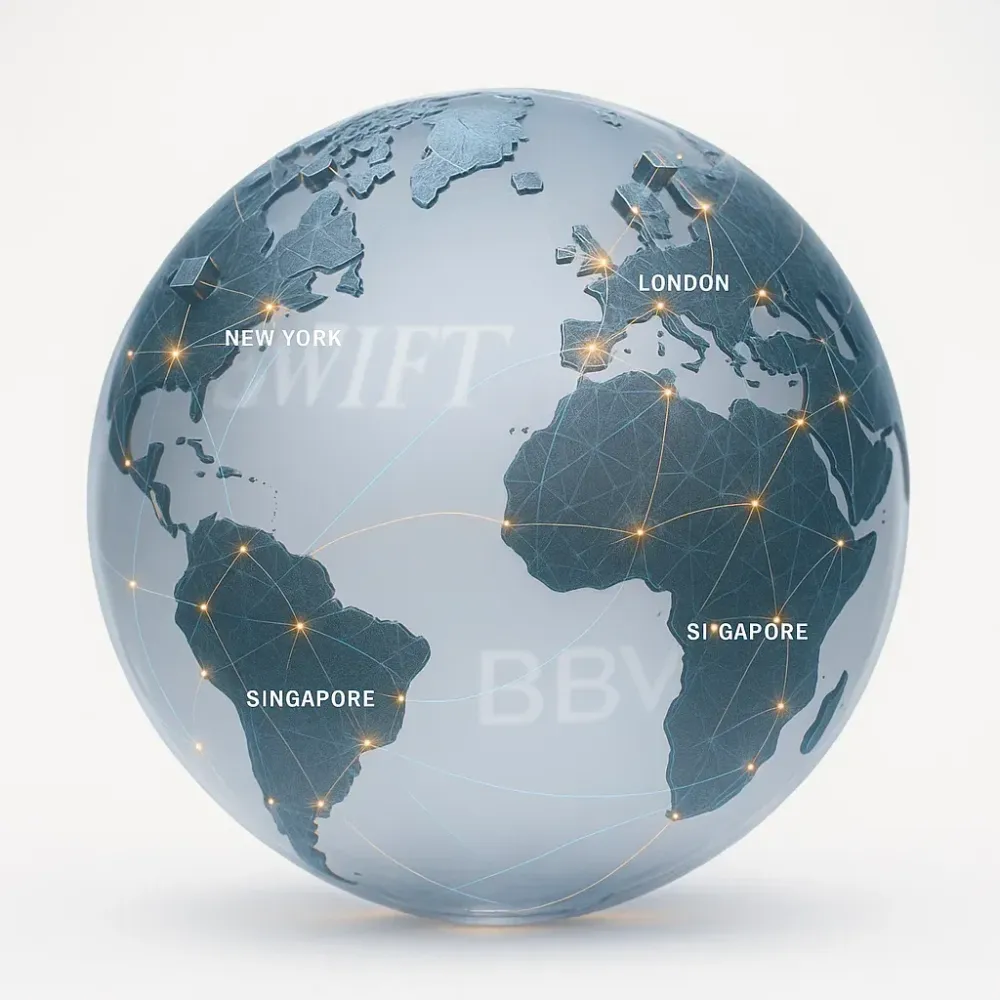
Global banking is getting a blockchain upgrade. Spain’s BBVA just joined a consortium of 30+ international banks in SWIFT’s blockchain initiative, aimed at turning cross-border payments into near-instant, transparent, programmable transactions.
The project marks SWIFT’s shift from being a messaging network to becoming a tokenized value movement platform.
Instead of banks sending “payment messages” across legacy rails, transactions will be recorded and validated directly on a public, secure digital ledger — in real time.
“SWIFT’s digital registry initiative represents a major step forward for the future of cross-border payments,” said Eva Rubio, Head of Global Transaction Banking at BBVA. “We’re committed to building the speed, transparency, and resilience that modern finance demands.”
⚙️ How It Works
The SWIFT blockchain registry operates like a universal ledger where each transaction — whether in dollars, euros, or stablecoins — is verified and settled instantly.
Here’s what powers the system:
- Smart contracts automatically validate and route transactions
- Tokenized assets — cash, bonds, deposits — move seamlessly across networks
- Stablecoins bridge fiat and digital rails
- Real-time visibility for all participants ensures compliance and auditability
This isn’t theory. It’s financial infrastructure, built for production scale — where blockchain replaces intermediaries with code.
🪙 Stablecoins + Tokenized Finance
SWIFT’s new platform isn’t just faster — it’s asset-agnostic. It supports both traditional currencies and digital representations of money, merging TradFi with DeFi under one roof.
Supported instruments include:
- 💵 Stablecoins: Pegged to fiat currencies (USD, EUR)
- 🏦 Tokenized deposits: Bank-issued, traceable digital cash
- 💰 Tokenized bonds: Tradable, programmable financial assets
The benefits:
- Instant settlement
- Full transaction traceability
- Reduced counterparty risk
This model gives banks an efficient, compliant path to experiment with tokenized finance — without breaking regulatory frameworks.
🤝 The ConsenSys Connection
To bring this vision to life, SWIFT is partnering with ConsenSys, the Ethereum-based software powerhouse behind MetaMask and Linea.
Their collaboration focuses on interoperability, ensuring that banks worldwide can transact across multiple blockchains securely and transparently.
The goal: a decentralized, shared ledger that connects global banks the same way the internet connects data.
📊 Why It Matters
This initiative could reshape the $150+ trillion global payments industry:
- ⚡ Speed: International transfers settle as fast as domestic ones
- 🔍 Transparency: Every transaction logged on an immutable ledger
- 💸 Cost Efficiency: Reduced need for intermediaries and manual reconciliation
- 🧩 Future-Proof: Ready for tokenized assets and CBDCs
BBVA’s move signals that blockchain in banking is no longer experimental — it’s operational.
🧠 Bigger Picture
This collaboration positions SWIFT at the center of the next generation of financial infrastructure — blending legacy reliability with blockchain efficiency.
For BBVA, it’s a strategic leap in its global digital transformation, reinforcing its status as one of Europe’s most forward-looking banks.
As stablecoins and tokenized assets scale, blockchain-based settlement may soon become the default language of cross-border finance.
TL;DR
- 🏦 BBVA joins SWIFT’s blockchain project with 30+ banks
- 💸 Enables real-time cross-border payments in fiat and digital assets
- 🪙 Built on ConsenSys blockchain infrastructure
- 🔍 Brings speed, transparency, and compliance to global transactions
- 🌍 Marks a paradigm shift from messaging to tokenized settlement
Recent News







All Time High • Live
Have questions or want to collaborate? Reach us at: [email protected]