🌍 Bitcoin’s Supercycle: Why the Bull Market May Run Until 2027
The four-year halving cycle is breaking down — replaced by a global liquidity wave that could push Bitcoin into its longest bull market in history.
⚡ Quick Facts
- Analysts at Bull Theory and ATH.LIVE argue Bitcoin is entering a liquidity-driven supercycle.
- The traditional four-year halving cycle is losing predictive power.
- Stablecoin supply is rising even during downturns — a sign institutions are not leaving.
- The U.S. Treasury General Account (TGA) sits at $940B, with expected liquidity release ahead.
- China, Japan, Canada, and the U.S. Federal Reserve are shifting toward easier monetary conditions.
- Bitcoin is now behaving like a macro asset, tied to global liquidity and central bank policy.
🔥 The Four-Year Cycle Is Dead — Here’s What Replaces It
For over a decade, Bitcoin followed a predictable pattern: halving → rally → crash → accumulation → repeat.
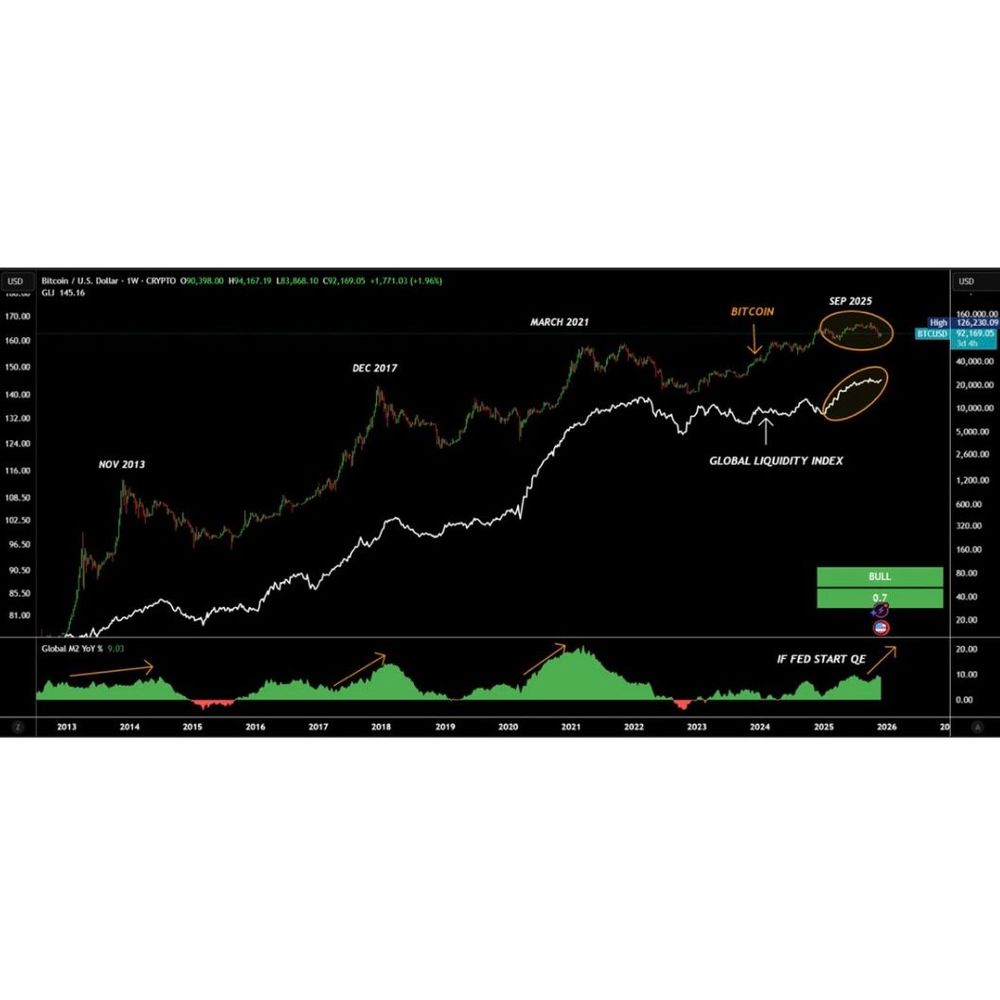
But according to Bull Theory and ATH.LIVE analysts, that era is ending. Bitcoin no longer responds to the halving schedule — it responds to global liquidity conditions.
The new thesis is blunt:
Bitcoin doesn’t run on a clock anymore. It runs on liquidity.
Looking back over the last decade, the largest Bitcoin rallies aligned not with halvings, but with changes in:
- global money supply (M2),
- interest rates,
- central bank balance sheets,
- credit expansion.
💵 Stablecoins: The Hidden Signal No One Is Ignoring
Even when markets dipped in 2025, one thing didn’t fall: stablecoin supply kept rising.
According to Bull Theory, this is the clearest sign that:
- large institutions never left crypto;
- they’re sitting in stablecoins, waiting for macro conditions to turn.
Stablecoin liquidity is the warm-up act for every major bull run — and it’s expanding again.
🏛️ The Treasury Factor: $940B Sitting on the Sidelines
The U.S. Treasury General Account (TGA) holds about $940 billion, roughly $90B above its usual range.
Historically, when the TGA releases excess funds into circulation, financial conditions ease — and liquidity flows into risk assets like Bitcoin.
That release is increasingly likely in 2026.
🌏 Global Liquidity Wave: China, Japan, Canada, and the U.S.
Outside the U.S., the liquidity picture is even more bullish:
- China has injected liquidity for months.
- Japan announced a ~$135B stimulus and is simplifying crypto regulations.
- Canada is moving toward monetary easing.
- The U.S. Federal Reserve has paused QT — historically a precursor to renewed monetary expansion.
When multiple major economies ease simultaneously, Bitcoin usually front-runs the shift.
🏦 The Magic Bullet: SLR Exemption Could Ignite Markets
A return of the Supplementary Leverage Ratio (SLR) exemption — last seen in 2020 — would allow banks to expand credit and lending dramatically.
Translation: an explosive increase in liquidity.
🇺🇸 The Political Tailwind No One Is Pricing In
Under a potential Trump administration, several proposals would significantly ease conditions for risk assets:
- Large-scale tax reform, including eliminating income tax.
- A proposed $2,000 tariff dividend.
- A possible crypto-friendly Federal Reserve Chair.
Together, these would accelerate capital flows into speculative assets — including Bitcoin.
📊 ATH.LIVE Perspective: Expansion Is Real, but Expectations Are Dangerous
While Bull Theory focuses on liquidity, ATH.LIVE adds market-structure nuance.
- Bitcoin is in an extended expansion and accumulation phase.
- The risk is not liquidity — it’s overheated retail expectations.
- The market now behaves like a macro asset, not a purely crypto-native one.
ATH.LIVE agrees: the bull market likely does NOT end in 2025.
If global liquidity remains favorable, the cycle may run through 2026–2027.
📈 Bitcoin’s New Fundamentals: M2, Bonds, Fed Policy, Geopolitics
Bitcoin is now tied to:
- global M2 money supply,
- bond markets and yield curves,
- central bank policy,
- geopolitical instability,
- institutional risk appetite.
If M2 keeps expanding and the Fed avoids aggressive tightening, Bitcoin may experience its longest bullish phase ever — up to three years.
📌 The PMI Trigger: The Indicator for Altseason
Bull Theory and ATH.LIVE highlight one overlooked metric: ISM PMI.
Historically:
- PMI above 55 → strong expansion
- Strong expansion → altseason
Given current global easing trends, PMI exceeding 55 in 2026 is increasingly likely.
🧩 Everything Converges: The Supercycle Framework
All major indicators point to a liquidity-driven supercycle:
- Rising stablecoin liquidity
- Treasury funds re-entering circulation
- Global monetary easing
- US QT paused
- Potential bank-lending relief
- Crypto-friendly political conditions
- Institutions accelerating adoption
- Regulatory clarity improving
Bitcoin is no longer following a halving clock — it’s following global liquidity flows.
If liquidity continues expanding across the U.S., China, Japan, and Canada, Bitcoin is unlikely to fight the macro tide. The bull run could stretch well into 2027.
🧩 TL;DR
- The four-year halving cycle is breaking down.
- Bitcoin is now a macro liquidity asset, not a calendar-driven one.
- Stablecoin growth shows institutions never left.
- Global liquidity expansion (U.S., China, Japan, Canada) supports multi-year upside.
- Bull Theory and ATH.LIVE project a cycle extending into 2026–2027.
- If M2 expands and the Fed remains dovish, this could become Bitcoin’s longest bull market ever.