Zcash: The Private NFT Revolution
Zcash NFT Ecosystem: 8 Projects to Watch
ZEC, the “strong-market” coin, is rising again.
From a low of around $200 earlier this year to nearly $1,500 now, ZEC has delivered an extremely strong rally, giving the market almost no time to catch its breath. As the price continues to climb, interest in ZEC has been rising as well, bringing the long-established privacy coin back into the spotlight as one of the most closely watched assets in the crypto market.
As the price continues to rise, capital and attention are also flowing back into the Zcash ecosystem. Recently, a number of NFT projects have begun attracting significant market interest.
This article by PNews looks at eight NFT projects that have already launched or are preparing to launch. Some NFT-related posts have received millions of views, while one auction reached a scale of tens of millions of dollars. Their approaches and positioning vary widely: some focus on private identity and community culture, while others attempt to add practical use cases and revenue-sharing mechanisms to NFTs.
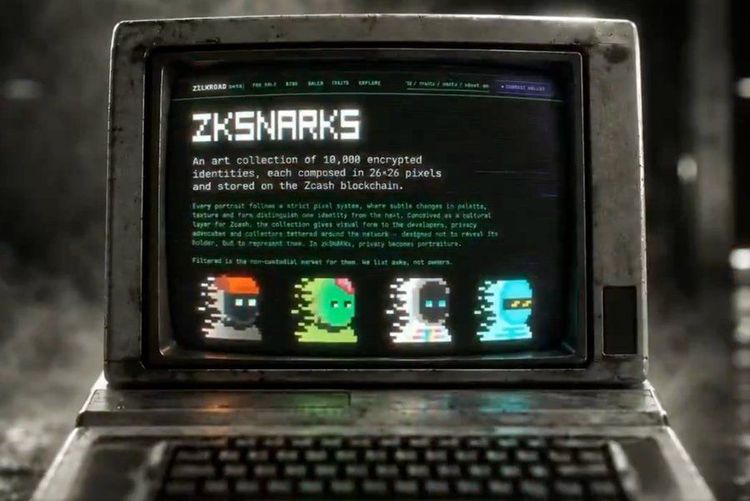
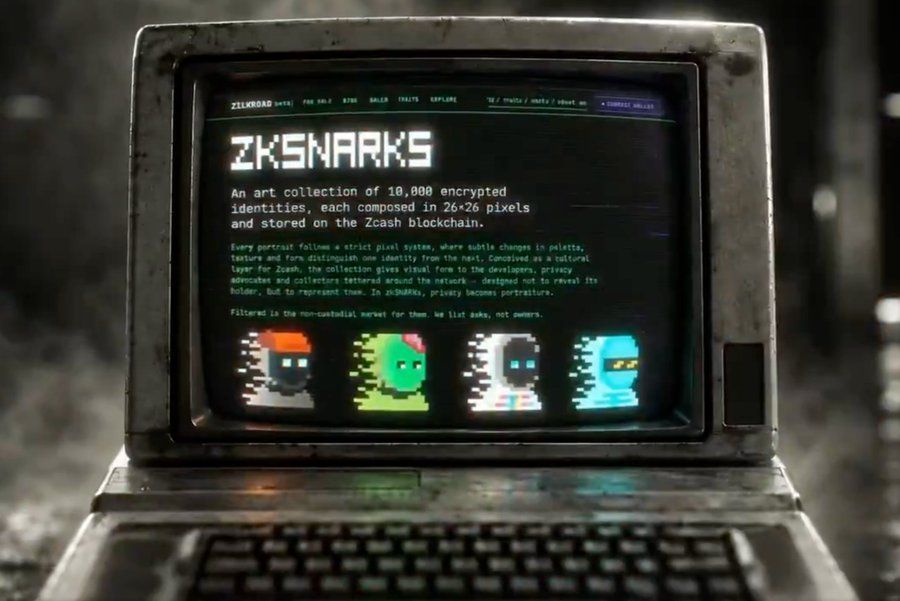
zkSNARKs
zkSNARKs is a private-identity collectible project with a total supply of 10,000 NFTs.
Of these, 8,000 were offered through a public blind auction, 1,000 were allocated to early Snarklist participants, and another 1,000 were placed in a treasury for community funding, contributors, artists, the team and other purposes.
The name zkSNARKs comes from the cryptographic technology behind Zcash — zk-SNARKs, or zero-knowledge succinct non-interactive arguments of knowledge. The technology allows users to prove that certain information or a transaction satisfies specific conditions without revealing the underlying data.
Zcash has previously used this technology for shielded transactions and has continued advancing zero-knowledge proofs through technologies such as Halo 2.
Unlike conventional NFTs, the core feature of zkSNARKs is that identity and ownership information are private by default. External users cannot directly determine the holder of a particular identity from on-chain data.
According to the project team, these identities may eventually be used for community access, reputation systems and other privacy-related applications, although their specific functionality is still under development.
The auction used a uniform clearing-price mechanism. It attracted a total of 16,971 bids, with a final clearing price of 1.5 ZEC, worth approximately $2,190 at the time. Total bids reached 25,305 ZEC, or approximately $36.94 million. Participants who did not win their bids received full refunds.
It is worth noting that Leonidas, a developer associated with Bitcoin Ordinals, has publicly accused the zkSNARKs team of previously being serial “entrepreneurs” in the Ordinals space, claiming that many of their projects were scams.
Zec Bit
Zec Bit is a native NFT project built on Zcash. It also provides an NFT marketplace and launch platform supporting NFT trading, offers and reservations.
Its core concept is not simply to create another PFP collection, but to use Zcash Shielded Assets (ZSA) to explore a model in which “the asset is public, while ownership is private by default.”
On traditional public blockchains, NFT holdings, transaction histories and relationships between wallets are generally visible. ZecBit aims to hide this information.
Collection information, supply, issuance records and other data can remain verifiable on-chain, while the identity of the holder, the number of NFTs they own and their transaction history remain private by default.
When necessary, users can choose to disclose proof of ownership.
ZecBit’s first collection is ZecBit Genesis — Shielded, consisting of 3,333 pixel-art generative NFTs.
The collection opened for free minting on September 3 and has now been fully minted and entered the secondary market. The current floor price is approximately 0.36 ZEC.
Holders of Genesis NFTs can also accumulate points that may provide priority access to future projects on the platform.
It is important to note that ZecBit currently operates primarily on the ZSA testnet. According to the project team, once ZSA is activated on the Zcash mainnet, the corresponding assets will be migrated to users’ own shielded wallets.
The exact mainnet activation date is not determined by the ZecBit team.
ZADDR
ZADDR is a privacy-focused experimental project built on Zcash. Its core concept is “readable identity + private-by-default payments.”
The idea is that a user’s name can remain public while payment amounts, senders and recipients, and other transaction information remain shielded by default.
For identity and collectibles, ZADDR has created a collection of 2,800 hand-drawn pixel-avatar NFTs stored in Zcash’s Orchard shielded pool.
A promotional post for the collection has received more than 1.5 million views. ZADDR has not yet announced an official mint date or price, but whitelist applications are already open.
According to the project team, thousands of applications have already been submitted. Applicants need to log in using an X account, complete designated tasks and submit a Zcash address, after which the team manually reviews applications.
Beyond NFTs, ZADDR is also attempting to create a more user-friendly identity system for Zcash.
Users can register a unique name between 3 and 20 characters instead of having to use a Zcash address that can be up to 178 characters long.
Once a payer enters the name, the system can resolve it to the corresponding Zcash address and complete the payment.
Users can also configure the address associated with their name themselves, pointing it to ZADDR, a hardware wallet or an exchange.
For asset security, ZADDR uses a model in which keys are generated and managed locally. Private keys are never uploaded to the server.
Zcash transaction construction, signing and zero-knowledge proof generation are all performed locally in the user’s browser. The server receives only the completed, already-signed transaction.
For cross-chain functionality, ZADDR has launched Crosspay, which uses NEAR Intents to facilitate cross-chain asset transfers.
It currently supports Bitcoin, Ethereum, Base, Solana and Tron, with additional cross-chain routes potentially available.
Users can exchange BTC, ETH, USDC and other assets into ZEC, or convert shielded ZEC into assets on other networks.
Cross-chain withdrawals charge a 1% fee, while deposits into Zcash are free.
ZADDR has also designed a reputation system called ZAD.
Users can earn ZAD through real activity such as sending, receiving, trading, cross-chain transactions and claiming names.
The points cannot be purchased, sold or transferred. They are intended to function more like an on-chain reputation record reflecting how users interact with the product.
Zecutives
Zecutives is the first native NFT collection launched by the privacy NFT marketplace ZEC MARKET.
The collection consists of 1,111 pixel-art “executive” avatars. Holders will be able to participate in a portion of the revenue generated by future projects launched through the platform.
Free minting is scheduled to begin soon.
Zecutives also emphasizes a model where the floor price remains publicly visible while holder identities remain private by default.
The NFTs and related assets are stored in a Zcash Shielded Vault, preventing external users from directly viewing information about individual holders.
For minting, Zecutives does not use ZEC directly. Instead, it uses the token $EXZEC.
The token is already listed on Stonkfun and trades against ZEC. Its total supply is 1 billion tokens.
Users need to burn $EXZEC on ZEC MARKET to mint Zecutives. The starting price is approximately 80,000 $EXZEC per NFT.
After every 25 NFTs are minted, the price increases by 3%.
The collection is capped at 1,111 NFTs, and each Vault can hold a maximum of three.
The NFT also includes a revenue-sharing mechanism.
According to the project, future collections minted on ZEC MARKET will incur a 10% platform fee, of which 2% will be distributed to Zecutives holders, weighted according to the number of NFTs held.
Previously migrated collections such as Genesis and Punks are not included in this revenue-sharing mechanism.
Of the $EXZEC burned during the minting process, half is destroyed while the other half goes into the project treasury.
BITFOOTS
BITFOOTS is an NFT collection centered around the theme of Bigfoot.
According to the project, BITFOOTS is not a rapidly generated NFT collection. Each piece is an individually planned and manually created 1/1 artwork.
From the artistic direction to the creation of the Bigfoot character, its world-building and overall visual identity, the project says it has invested more than 1,000 hours of work.
Unlike traditional PFPs on public ledgers, BITFOOTS combines the mystery of the Bigfoot narrative with Zcash’s privacy mechanisms.
The project describes the characters as “hidden creatures in the on-chain forest.”
The artwork can exist on-chain, but holders do not need to expose their entire wallet profile as they would with a conventional NFT.
Instead of simply purchasing a profile picture, users are presented with the idea of “discovering” a Bitfoot on the blockchain.
The project was originally planned for release through Bitcoin Ordinals.
The team had already completed the inscription of the entire collection on Bitcoin and had worked directly with the Magic Eden team to complete the relevant process.
However, due to changing market conditions, the launch was ultimately postponed.
The project has now chosen to restart on Zcash, hoping to use its privacy features to redefine how the collection is issued and owned.
The current mint price is approximately $5, payable in ZEC. The project says this fee is primarily intended to cover Launchpad and network costs.
The project uses a whitelist-based application system. Users must submit an application and receive approval before participating in the mint. Approved users can also invite friends.
BITFOOTS has also designed a dual-chain model combining Zcash and Bitcoin Ordinals.
After minting on Zcash, users can submit an approved Bitcoin Ordinals address and receive a corresponding Bitcoin version for free.
Some pieces also feature Ordinals-exclusive colors or characteristics.
Zec Punks
Zec Punks is described as the first Punks-style NFT collection in the Zcash ecosystem.
The collection consists of 1,555 pixel-art Punks. Each piece is based on a 24×24 grid and generated through hand-drawn trait combinations, with an overall style similar to the classic CryptoPunks collection.
According to the project team, there are no hidden reserves and no second edition will be released.
The collection completed its mint on September 15.
The mint price was 0.015 ZEC, and participants were required to use a shielded Zcash address beginning with u1. Transparent addresses were not eligible.
The collection is now completely sold out.
Beyond the NFTs themselves, the official Zec Punks account has recently begun teasing future utility and developments, although specific plans have not yet been announced.
ZecCat
ZecCat is a pixel-art cat NFT project currently being developed on the Zcash mainnet.
The project plans to issue 3,333 unique pixel cats.
It uses the ZRC-721 JSON inscriptions format. NFTs exist as inscriptions and their corresponding on-chain carriers, while ownership follows the application-level rules disclosed by the project and moves together with the UTXO carrying the inscription.
Minting and trading have not yet opened, and the exact mint date and price remain unknown.
ZecCat has already opened whitelist applications.
Users do not need to connect a wallet or pay a fee. They only need to submit an X username and a Zcash mainnet transparent address beginning with t1.
Each X account and t1 address can only be submitted once.
The whitelist will use a combination of random guaranteed allocation and FCFS selection. The project also plans additional allocation benefits for qualifying original-content contributors.
ZecCat has designed an independent NFT Vault to improve NFT security.
According to the project’s published system design, user wallets will separately generate a Payment Address for everyday transactions and an NFT Vault Address specifically for storing NFT carriers.
This is intended to reduce the risk of accidentally using an NFT carrier as a payment input during normal transactions.
The project also plans to have minting, transfers, listings and purchases signed locally by users, while the wallet identifies and protects NFT carriers.
Beyond the NFT collection itself, ZecCat plans to build its own marketplace supporting collection browsing, portfolio management, listings, purchase requests and item offers.
The platform also plans to introduce fee discounts and other utility for NFT holders.
ZecFrogs
ZecFrogs is a pixel-art frog NFT project on Zcash.
The collection plans to issue 6,969 Pixel Frogs and positions itself as one of the first frog-themed NFT collections on Zcash.
The team hopes to use the frog collection as an entry point for building a broader Zcash ecosystem called the “Pond.”
ZecFrogs is preparing to launch a free mint.
The mint will only support Noir Wallet u1 shielded addresses.
Users need to keep at least 0.007 ZEC in their wallet in advance to cover gas and related protocol fees.
Users who have not yet joined Froglist can still apply for the whitelist through the official website.
Beyond the NFT collection, ZecFrogs is also developing ZecPad, an infrastructure project positioned as a Launchpad and marketplace for the Zcash ecosystem.
The goal is to provide NFT issuance and secondary-market trading infrastructure.
Zecutives
Zecutives is the native NFT collection launched by ZEC MARKET and consists of 1,111 pixel-art executive avatars.
The project combines private NFT ownership with a potential revenue-sharing mechanism tied to future collections launched through the marketplace.
Its model reflects a broader trend emerging across the Zcash NFT ecosystem: keeping asset-level information verifiable while protecting the identity and financial history of the holder.
Rather than simply reproducing the NFT model established on transparent blockchains, these projects are experimenting with a different concept of digital ownership — one in which ownership can be proven without necessarily making the owner’s entire financial activity public.
The broader significance of these projects may therefore lie less in the individual NFT collections and more in the infrastructure they are testing.
If the model succeeds, Zcash could develop an NFT ecosystem where digital assets remain verifiable while ownership, wallet relationships and transaction histories can remain private by default.
Recent News





All Time High • Live
Have questions or want to collaborate? Reach us at: [email protected]