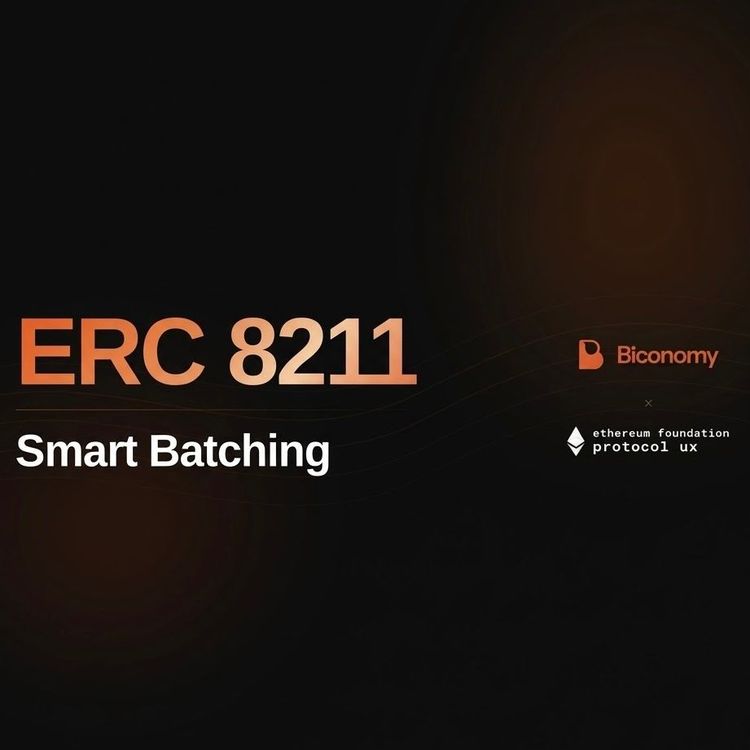
ERC-8211 — Ethereum’s Smart Batching Unlocks Agentic DeFi
ERC-8211 — Ethereum Just Turned Transactions Into Programs 🤖⚡
AI agents are getting smarter.
But Ethereum transactions? Still stuck in static mode.
Now ERC-8211 changes that.
Instead of fixed transaction batches — Ethereum introduces runtime programmable execution.
One signature. Multi-step DeFi. Dynamic execution.
And suddenly — Agentic DeFi becomes real.
Summary 🧠
- ERC-8211 introduces programmable runtime execution
- AI agents can run multi-step DeFi strategies in one signature
- Fixes static batching limitations like ERC-4337
- Enables dynamic execution using live onchain data
- Signals shift toward autonomous financial agents
The Problem: AI Got Smarter — Execution Didn’t 🤖
AI agents already:
- Rebalance portfolios
- Execute trades
- Manage treasuries
- Interact with DeFi protocols
But there’s a mismatch:
👉 Intelligence scaled 👉 Execution didn’t
Most agents today are still limited to:
- Simple swaps
- Basic transfers
Not because AI is weak — but because Ethereum execution is static.
And DeFi? It’s anything but static.
Why Current Execution Breaks 💥
Existing standards like ERC-4337 rely on pre-defined batches.
That means:
- Parameters fixed at signing
- Calldata pre-encoded
- No runtime adaptation
But DeFi changes constantly:
- Slippage changes swap outputs
- Lending balances grow
- Bridge timing is unpredictable
Example:
Agent:
Swap ETH → USDC Deposit USDC into lending protocol
If estimate is wrong:
Too high → transaction fails Too low → capital sits idle
👉 There's no way to say:
"Use whatever I actually received."
Until now.
ERC-8211: Transactions Become Programs 🧩
ERC-8211 flips the model.
Instead of static transactions → Transactions become runtime programs.
At execution:
- Pull live onchain values
- Validate constraints
- Execute dynamically
No stale estimates. No broken batches. No manual adjustments.
What This Unlocks 🚀
Multi-Step DeFi in One Signature
Swap → Lend → Stake → Rebalance All dynamically chained.
No More "Dust"
Use exact balances — no leftover funds.
Cross-Chain Automation
Bridge → Wait → Execute automatically
Profit Guards
Agents can enforce:
👉 "Execute only if profitable"
Leverage Loops
Collateral → Borrow → Swap → Repeat With built-in safety constraints.
Why This Matters
This is the missing layer for Agentic DeFi.
AI agents can now:
- Plan strategies off-chain
- Encode execution logic
- Sign once
- Let infrastructure execute
No smart contracts No repeated signing No execution failures
👉 The agent thinks. 👉 Ethereum executes.
The Bigger Shift: Agentic Finance 🤖
ERC-8211 signals a structural transition:
From:
- User-driven DeFi
- Manual execution
- UI-based interaction
To:
- Agent-driven finance
- Autonomous execution
- Infrastructure-level automation
Ethereum is quietly building Agent Economy infrastructure.
Ethereum’s Agent Stack Is Forming 🧠
- ERC-4337 → Account abstraction
- ERC-7683 → Cross-chain intents
- ERC-8211 → Dynamic execution
Together:
Ethereum becomes infrastructure for autonomous finance.
TL;DR 🧠
- ERC-8211 introduces programmable transaction execution
- AI agents can run multi-step DeFi strategies
- Transactions adapt dynamically at runtime
- Fixes static batching limitations
- Signals rise of Agentic DeFi
Ethereum just upgraded from transactions… to programmable financial agents.
📚 Read Also
Recent News







All Time High • Live
Have questions or want to collaborate? Reach us at: [email protected]